
Smart home brands that shut down or changed the deal, and how to spot the next one
I want to start by being honest about what this article is, because the deal I make with you every time is that I do not fake experiences I do not have.
I never owned a Wink hub or Insteon or a Lowe’s Iris starter kit. So I am not going to tell you a war story about the morning my hub turned into a paperweight, because it did not happen to me. What did happen is that while building out a catalog of smart home gear, I kept running into the same quiet little flag on product after product: discontinued. Dead brand. Cloud turned off. And a few of those were sitting one aisle over from stuff I run in my own house.
So I did the boring thing. I went and read what happened to each of these brands, from news coverage at the time and from the companies’ own shutdown notices, and I lined it up against the products in my catalog that carry that discontinued flag. This is the plain version of what I found, with every date linked so you can check me. Consider it a running list of what happened, plus the one thing that matters: how to see the next one coming.
Two ways a smart home brand fails you
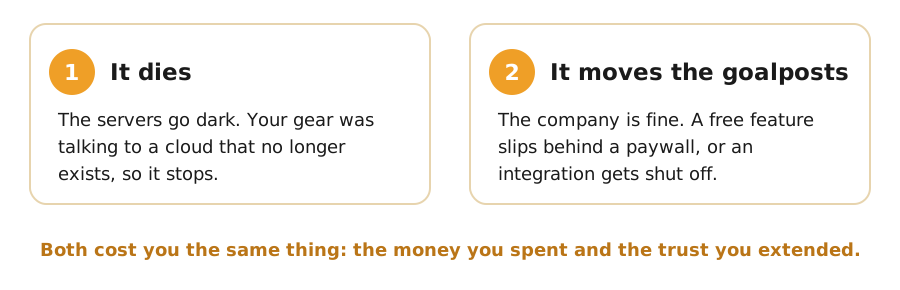
Before the names, here is the frame that made all of it click for me. A brand does not have to die to burn you. There are really two failure modes.
The first is the obvious one. The company goes under, or gives up, and the servers go dark. Your gear was talking to a cloud that no longer exists, so it stops. This is the bricking story.
The second is sneakier. The company is alive and well, and it changes the deal after you have already bought in. A feature that was free is now behind a subscription. An integration you relied on gets shut off. The hardware still powers on, but the thing you actually bought it for is gone or costs money now. Usually there is no notice, and one day you notice the goalposts moved.
Both cost you the same thing in the end, which is the money you spent and the trust you extended. So both belong on this list.
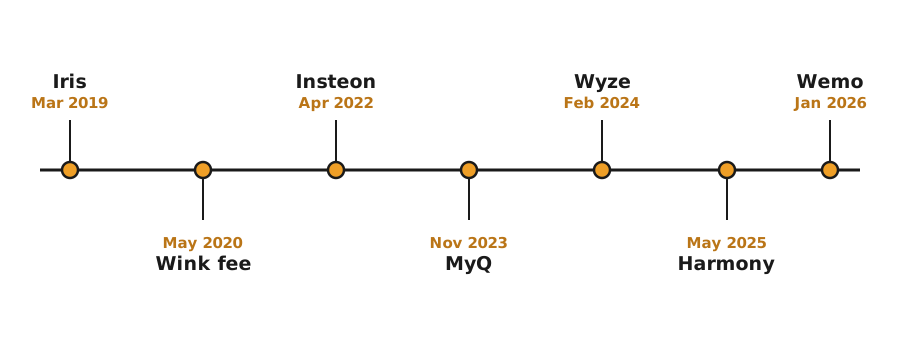
Here is the last seven years of it on one line, so you can see how steady the drumbeat has been:
Way one: the brand dies on you
Insteon: gone overnight, then bought back by its own users
Insteon shut down with zero warning. In April 2022, Insteon simply switched its servers off and went quiet. No email, no heads up. The Register reported that the parent company was insolvent and had assigned its assets off to be sold. Anyone with an Insteon hub woke up to a dead system. There is a twist: a group of Insteon users bought the company later that year and brought the cloud back, and it operates again today under new ownership. But the protocol is proprietary powerline gear, the parts are pricey, and the customer base shrank. If you already run a healthy Insteon setup and love it, fine. If you are starting from scratch in 2026, there is no strong reason to pick Insteon over Z-Wave, Zigbee, or Matter, which are open standards that do not depend on one company’s servers staying on.
Iris: dead hardware, but Lowe’s paid people back
Iris by Lowe’s is the cleanest example of dead hardware. Lowe’s shut the platform down on March 31, 2019, and the hubs stopped working that day, as Engadget and others reported. Lowe’s handed out prepaid Visa cards for the gear that could not be used anywhere else, which a lot of people spent on SmartThings or Hubitat. Here is the one useful bit if you inherit some Iris gear: the Zigbee and Z-Wave sensors that shipped with it can often be re-paired to a modern hub and live on. The Iris hub itself does nothing once the service is gone. If you ever see an Iris hub listed as a “smart home starter kit” on a marketplace, know that the hub part no longer functions.
Wemo: the one that just happened
This is the one that makes the list feel current rather than like old history, because it just happened, and plenty of these plugs are still sitting on shelves and in resale listings.
Belkin ended support for most of its Wemo line on January 31, 2026. Since that date the Wemo app and all of its cloud features are gone, which means remote control and the Alexa and Google Assistant integrations went with them, as Belkin laid out in its own shutdown notice and TechCrunch covered when the plan was announced. There was a narrow escape hatch: any Wemo device you had already set up with Apple Home before the cutoff keeps working locally through the Home app, but you can no longer add a new one to HomeKit. If your device was still under warranty on that date, you may have been owed a refund.
I bring up Wemo specifically because it shows the catalog doing its job. In the catalog I built, the Wemo smart plug with Thread and the Wemo Wi-Fi 3-way switch carry a discontinued flag stamped with that January 31, 2026 date, so if you land on one of those pages you get the warning before you buy, not after. That is the entire point of putting compatibility and lifecycle data behind a store instead of just a spec sheet. A Wemo plug is still a fine dumb plug in a wall. It is just not the smart plug you thought you were buying anymore.
Way two: the brand moves the goalposts
These brands did not die. Most of them are alive and doing fine, and they changed the deal on you anyway: a free feature slips behind a subscription, or an integration you relied on gets switched off. That is the unsettling part. A perfectly healthy company can move the goalposts too.
Wink: “no monthly fees” that became a monthly fee
Wink is the cautionary tale everyone points to. Wink sold a hub that worked well, and it leaned on “no monthly fees” as a selling point against its rivals. Then in May 2020, with about a week of notice, the company told everyone they now had to pay $4.99 a month or the hub would stop responding to the app, as Consumer Reports covered at the time. People who had specifically bought Wink to avoid a subscription faced a subscription or a dead hub. The lesson is bigger than Wink: when the whole pitch is “no monthly fees,” ask yourself how the company keeps the lights on, because if the answer is “venture money,” the fee can arrive later, once your gear already depends on it.
Chamberlain MyQ: the integration that got shut off
Chamberlain MyQ is the integration example. In November 2023, Chamberlain blocked the unofficial access that Home Assistant, Homebridge, and similar tools had been using to control MyQ garage door openers, and Home Assistant responded by removing its MyQ integration entirely. Chamberlain described the third-party access as unauthorized and pointed users to its own paid partnership instead. Your opener still opens your garage. It just stopped talking to your smart home. I dodged this one by luck, since I run a Genie Aladdin Connect opener rather than MyQ, but I watched it hit a lot of people who did everything right. The community fix is a small board called ratgdo that wires into the existing opener and exposes it locally, no vendor cloud required. If you are buying a new opener, that local-control ability is the thing to look for.
Nest: the account that quietly locks you out
Nest is the account example, and it is a slow one. Google shut down the Works with Nest program on August 31, 2019, replacing it with a Google-account-based system. A lot of people held onto their old Nest accounts specifically because migrating to a Google account permanently ends those old Works with Nest connections, and that migration is a one-way door. Google has been retiring the legacy accounts over time since. If you are sitting on a legacy Nest login keeping some integration alive, treat it as “when it breaks,” not “if.”
Ring: the camera that needs a subscription to record
Ring is the subscription example, and it is the one most likely to affect somebody reading this, because Ring is everywhere and I run Ring cameras myself. Out of the box, a Ring camera or doorbell gives you a live view and a motion notification. That is it. No recorded video, no history, no replay unless you pay. As of now the plans are Ring Solo at $4.99 a month for a single device, Ring Multi at $9.99 a month for all your devices at one home, and Ring Pro at $19.99 a month. Ring is upfront about this, but it is worth saying plainly because the box looks like a $100 camera and the real cost is $100 plus a monthly bill for as long as you own it. If a subscription is a dealbreaker for you, cameras from Reolink, Aqara, or a plain PoE camera with a local recorder will store footage without a monthly fee.
One more thing to weigh: a brand’s track record
This one is not a shutdown or a goalpost move, but it belongs in the same buying decision. In February 2024, a caching bug at Wyze let roughly 13,000 users briefly see thumbnails from other people’s cameras, and more than 1,500 of them tapped in. Wyze says it affected a small share of its users and it added a verification layer afterward. Wyze cameras work and they are inexpensive, and a company’s track record is simply part of what you are weighing, especially for a device pointed into your home. Buy with your eyes open, and a good rule for any budget cloud camera is to keep it out of bedrooms and bathrooms.
Not every discontinuation is a bricking
I do not want to leave you paranoid, so here is the fair counterexample. Logitech discontinued its Harmony universal remotes back in April 2021, and a lot of people braced for a Wink-style bricking. It did not come. Logitech kept the service running for years, and it was only in May 2025 that it ended account access for reprogramming the older remotes, with newer models still supported through the app. The remotes keep working, you just eventually cannot reconfigure the oldest ones.
That is what a discontinuation done with some runway looks like: years of notice, and the hardware you paid for keeps doing its job. It is the difference between a company winding a product down gracefully and a company turning the cloud off with little warning. Both show up as “discontinued” on a spec sheet. Only one of them leaves you stranded.
How to spot the next one before it happens
This is the part worth keeping, because the list keeps growing and the tells are almost always the same. None of these alone means doom. But when three of them cluster on the same brand, I move it to “no new purchases” and start planning my exit.
- Long silence on firmware. A healthy smart home product gets updates. Months of nothing is a company that has stopped investing.
- New owners who keep cutting. An acquisition followed by features quietly disappearing is a brand being harvested, not grown.
- A forum full of “this used to work.” When every other post is people mourning a feature, believe them.
- A forced app rebuild that loses features. A “new app” that does less than the old one is a downgrade wearing a party hat.
- A free feature suddenly behind a subscription. This is the Wink move, and it is the loudest alarm of all.
The good news buried in that list is that you almost always get months of warning if you are paying attention. Shutdowns feel sudden to the people who were not watching.
The best defense, the one that outlasts any single brand, is open protocols and local control. A Z-Wave or Zigbee sensor, or a Matter device, or anything that runs locally through a hub you control, does not care whether the manufacturer is having a good year. My most trusted gear is the boring stuff on open standards, precisely because no single company’s servers can reach out and turn it off. When a brand can brick your device from a server, you never really owned it. You were renting, and the landlord can leave.
Did it work?
Your call. This one genuinely depends on where you are standing.
If you already own gear from one of these brands and it still works, do not panic-replace it. A working device owes you nothing, and Insteon and Harmony both show that “discontinued” and “dead” are not always the same word. Watch for the tells, keep an exit in mind, and enjoy it until it gives you a reason not to.
Before you spend real money on a smart home brand, run down four boring questions.
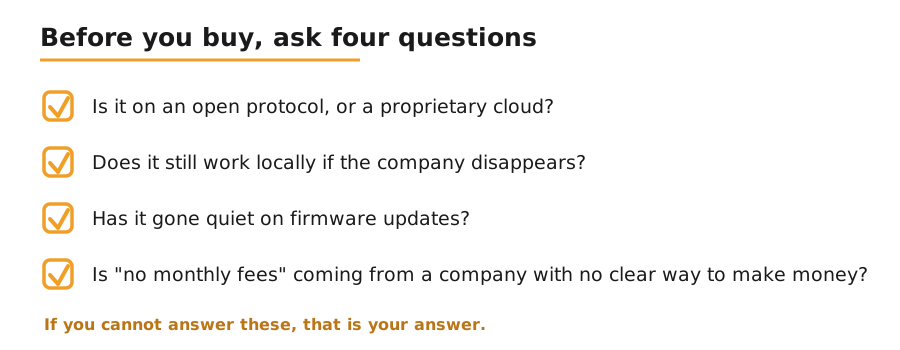
Those four questions are the cheapest insurance in this whole hobby, and it is the exact check I am trying to bake into every product page in the catalog so you do not have to do it alone.
Joe out.